A common theme of peering into doorways, literal or otherwise,

allows the work to spread out and deeply exhale. She says "
I made them all as they occurred to me and so they document my feelings and experiences during the time of making. Some are tongue-in-cheek, like Tea with the Arabs....... ... some funny, and some full of fear like the Gargoyles (Dengue Nightmare). I made this piece while Rory was ill with dengue fever in September - it was cathartic pouring out of all those fearful beasts."
Leaves, trees, and fantastical organic forms carry through the feeling of deep, unexplored territory. Exploring the dense, virgin landscape of Trinidad's lush northern range has obviously made an indelible mark on Bunty's psyche and this emerges in the turn of a leaf or the shape of a tree.
In Ground Provisions (above) the coiled leaf of the dasheen unfurls to reveal playful, but undoubtedly elderly, sprite and the subterranean dasheen is a fat, lovely, earthbaby.
In "Coming Out of Her Shell", the girl/snail captures the essence of the Caribbean, "kiss-me-nah?" attitude that is our home-grown version of a bad girl. But she is achingly beautiful in her vulnerability as she comes out of her shell.

Like many artists, place and landscape are integral to the work. While hiking in the forest, Bunty and Rory visited and camped overnight at the plane crash site of Mikey Cipriani. In the 1930's, the small light aircraft piloted by Cipriani and a friend crashed in the northern range while enroute to Tobago. The death of this charismatic, handsome young pilot captured the nation's attention. Bunty describes the site as a place of serene beauty.

"The Place Where Mikey Cipriani Crashed His Plane" is part memorial, part tribute to this as yet un-commemorated spot.

"Homage to Hands" is a commanding piece with an almost Rodin-type feel. Bunty tells the story that she created them to be apart, open and upturned. Rory had a different idea and would entwine them every time he passed by. This little performance art ritual-of-the-hands only adds to the piece.
I have chosen to highlight just a few of the pieces but there are many others that are just as evocative and magically delightful as the ones that I've shown here.

Amerindian Doggy has just joined my pack. I had to have him.

Bunty prefaces her Artist Statement with a quote from STARBOOK by Ben Okri.
"Voice: If you enter through the magic gate, if you walk through the encampment of the tribe.......You will find them carving at wood scuptures in open workshops, hammering at bronze, singing poignant songs in groups, in lovely harmonies. You will see the children making new objects out of rejects, drawing pictures on the ground. You will see the women painting cloth in vivid colours, or creating new forms with jeweld and cowries. practising new dances in the square. You will find the old at work, directing great projects, telling stories to the young, listening to the dreams of maidens."
STARBOOK, by Ben Okri


.JPG)
 Social unrest and emerging nationalism in the late 19th and early 20th century provided a fertile environment for the development of the musical instrument that would come to symbolise our national identity. Most steelpan historians agree that pan was born of the strong African tradition of drumming that travelled with displaced Africans across the Atlantic. Drumming was recognised by the colonial government as a powerful force and was subsequently banned in the late 1800's. There ensued a battle for the very soul of Carnival. The French planters with their traditions of masquerade fought a cultural war with the emancipated masses who incorporated mimicry, lewd dancing, ribald revelry, and general "get-on-bad" behaviour as a way of making their mark on a new homeland and as a distinct "thumbing their noses" to the pretensions of the socially conscious upper classes.
  Ultimately Carnival as we know it today is the product of the rocky marriage of these social groups with influences from Indian and Portuguese indentured labour and the cocoa "panyols" from the mainland.Each wave of immigrants would bring their magpie offering to the Carnival.
.JPG) Today Carnival belongs to all Trinidadians - each year it expands and breathes a healing breath into the nation's pysche.
Today Carnival belongs to all Trinidadians - each year it expands and breathes a healing breath into the nation's pysche..JPG)
.JPG) The first instruments developed in the evolution of steelpan were Tamboo-Bamboos, tunable sticks made of
The first instruments developed in the evolution of steelpan were Tamboo-Bamboos, tunable sticks made of .JPG) By the late 1930s there occasional all-steel bands were seen at Carnival and by 1940 it had become the preferred Carnival accompaniment of young underprivileged men. The 55-gallon oil drum was used to make lead steelpans from around 1947.
By the late 1930s there occasional all-steel bands were seen at Carnival and by 1940 it had become the preferred Carnival accompaniment of young underprivileged men. The 55-gallon oil drum was used to make lead steelpans from around 1947. The Trinidad All Steel Percussion Orchestra (TASPO), formed to attend the Festival of Britain in 1951, was the first steelband whose instruments were all made from oil drums. Members of
 .JPG)
 One of the three Actors
 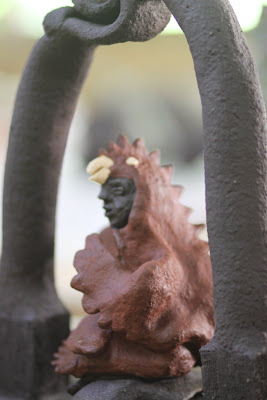 The Child.


 To walk in the garden is a privilege. Bunty is doing tremendous work with seed collecting and propogation of indigenous trees. The family hikes regularly and much of her inspiration and creative spirit comes from this close connection with her landscape. She is surrounded by five acres of slightly undulating land that looks northwards up to the northern range and throws a backward glance to Tamana in the central range.
 The patio that opens out onto the garden and which can be populated at any time with chickens, cats, dogs, grandchildren or an assorted mix of the above.
 And as if organic eggs were not impressive enough, here are her fresh healthy lettuce. YUM!