I have started to set goals for 2008 and an orchid house is right up there at the top of the list. At the moment, my orchids are all over the garden and I have to keep moving them depending on the amount of rainfall , the angle of the sun and other random factors. I visited the beautiful home of the Craig family. This spectacular home overlooks the St Ann's valley and like everything else I saw on this property, the orchid house was a masterpiece of ingenuity. The orchids are watered three times a day for 4 minutes via a timer that has been placed on the water line. The large fan is also turned on to keep the heat down in the shed which is protected from the weather by shade cloth, over which lies a layer of plastic. This makes the environment far easier to control and means that all orchids can be fertilized, sprayed, re-potted and generally cared for in a far more consistent manner than can ever be achieved out in the open weather.
Vandas are attached to the Eastern end and so get the rising sun. The oncidiums, cattleyas, dendrobiums and phaleonopsis are all arranged so that they receive ideal lighting conditions. Of course, the romantic in me still clings to the idea of the orchids growing splendidly up in the canopies of my trees and attached to side of my mango trees but realistically, I am hiding my head in the sand with this approach as everyone, bar none, agrees that orchids thrive once put into a more controlled environment.
 I have never done well with phaleonopsis and when I see them doing so well and looking so happy, I am tempted to try again.
Sunday, 9 December 2007
The Orchid House Project

Sunday Green Thumb

I am sitting at my computer tonight and there is a cool, December breeze coming down the St Ann's valley. A true Christmas breeze. Our temperature never dips substantially enough to have an impact on the garden. But it certainly puts me in the mood for some sorrel, ponchecrema (our rum-laced egg nog), a nice tasty pastelle (cornmeal patties wrapped in banana leaves and steamed in a colander) and a big slice of ham with some cloves studded in for that extra special Christmas flavour). But that's a whole different post.
Tonight I am celebrating Green Thumb Sunday and sending out lots of planting energy to fellow bloggers the world over.
 This wild plant was brought to me by my gardener and has done very well in the shade of my saman tree. It is a wild pachystachys (pachystachys spicata, syn. P. coccinea) and looks quite similar to its cousin the yellow shrimp plant or yellow pachystchys (Pachystachys lutea) . This plant acts slightly differently in that it spreads via running, rooting stems. So if it miraculously multiplies, this is the reason. The overlapping bracts from which the inflorescences emerge are fascinating in their symmetrical order.
I've sneaked in a vase of zinnias that I have next to my computer. I love the chunky, painted sunflowers on the glass almost as much as the zinnias. The light in this room in the afternoon is really special and almost everything I shoot in here has this soft, warm colouring.
 Crotons make up an extraordinarily large family and are categorized by leaf shape and size. They tend to do best in filtered light. Mixed light encourages the best colour variation. It is not unusual to have several shades of contrasting colour on one leaf. They root easily, making them very easy to propagate and satisfying to grow. A cutting will last for several weeks indoors in a vase, often rooting in the water.
I am rooting two new ones at the moment. I picked them up while visiting a friend in San Fernando. One of Trinidad's well known horticulturalists, Mrs. Rita Barrow, once said that the secret to successful landscaping in the tropics lay in crotons.
They can always be counted on to provide colour, shape and texture and most will hedge as happily as they will shrub.
 The very talented team of mother and daughter, Margaret and Vanessa Dalla Costa do really lovely work. This Taj is an example of their imaginative mosaics. This piece was calling to be in my garden. So here it is in its new place of glory; in with the bromeliads, under the sexy orange heliconias and next to my large copper.
Friday, 7 December 2007
Sorrel
At Christmas time in Trinidad, this is a common sight. Sorrel, which is a member of the hibiscus family (Hibiscus sabdariffa), is tradionally used to make one of Trinidad and Tobago's most beloved national Christmas drinks. The population takes its cue from signs such as the sorrel-laden vans that appear on the side of the highways selling their fare, as a signal that the season is officially open. The late appearance of sorrel can have a significant impact on the general Christmass-y feeling that pervades the both islands. The fleshy sepals are peeled away from the green base and soaked to "draw' the flavor. Sorrel has an astringent flavor that is quite unique. Almost cranberry like. Clove, cinnamon and ginger can all be added to improve the flavor. So how exactly do you go from the aesthetic beauty of a truck load of fat magenta sepals to the clear, crimson drink that is synonymous with the season?
Everyone's recipe is different, but you must start with at least five pounds of sorrel. It will shrink, don't worry. Choose crisp, fresh sorrel that snaps easily.
 When you arrive home, settle down with some good company or an excellent Christmas movie to get you in the mood or, a completely fool proof way, put some Daisy Voisin on the Ipod.
 Sit with two large bowls. Start peeling your sepals away from their green seed. Put the seeds in one bowl and your sepals in another. Have fun and feel very virtuous and Christmass-y for about 10 minutes.After which time, expect to get irritated that no one told you that the prickly, little fuzz on each sepal is very itchy and peeling sorrel is very time consuming. Make a mental note to self not to get taken by the pretty vans next year and promise to buy the ready made Orchard packs.However, never be tempted to boil the whole sorrel, the green seed will dramatically change the flavor and gives it an almost musky undertone. Persist, it will be worth it.

When all the sepals have been peeled away, wash carefully and place in large pot and bring to the boil. Add a handful of fresh cloves, 2-3 pieces of cinnamon bark, 1 smashed one inch piece of ginger root. Turn off heat and leave in pot overnight to allow flavor to steep. The next morning, most off the color will have leeched from the sorrel and the liquid should be lovely and crimson. Strain and sweeten with white sugar to taste. You will be amazed at the amount of sugar that it takes to sweeten sorrel. It's quite alarming actually. It is also possible to make a simple syrup and sweeten to taste with that, it does mix easily. When I bottle my sorrel, I leave my cloves in but remove the cinnamon and ginger by straining the whole batch. Some people add bay leaf or orange peel and use brown sugar. Either sugar is fine but I personally find that brown sugar changes the clarity of the final drink. I will not even give an estimate of the amount of sugar that you will need, but suffice to say that you can safely start with a cup and go from there. Bottle, refrigerate and enjoy.
Thursday, 6 December 2007
This and That
My childhood home where I lived until I got married at 29. My parents moved in just before I was born so I know every nook and cranny of this property . All my childhood memories come out of here. I used to lie in the living room as a teenager and read for hours on end and during the rainy season, hear the rain coming down the mountain long before it arrived.
Many an afternoon was spent sitting on this porch with visitors and having the customary sundown drink. The bottle brush trees are in the background.

Desert Rose is an unusual plant to find in the tropics. It is the equvalent of our "hot-house" flowers taking that interpretation to mean a plant that has to have special conditions put in place to ensure success. My father loves Desert Roses and tends to them almost (almost!) as assiduously as he does the lawn. I was so pleased to see them doing well and in full flower when I visited on Tuesday, The garden, as always, pulls up strong emotions. This petrea in coming into full and beautiful bloom. It was my mother's favorite tree and she would call me to come down to see it when it was in full glory. Often I would have to pose in front of the tree while she took a picture of it. My earliest memories are trailing behind Mummy in the garden at that dusk hour that is so magical in the tropics. We did not necessarily agree on gardening styles, Mummy adored the wild unkept, let the plant behave however it wants approach and I took the prune, shape and guide approach. When I moved into my home and felt as if I was living in the jungle, I gave everything a good, hard prune just before the rains and she was horrified. Why cut? I miss her terribly especially at times when I see her favorite trees still blooming, oblivious to the lack of her physical presence. I can only hope that she is enjoying the Petrea from a happy, content place.
 Every single time I visit my parent's home, this blackbird is swimming in this pothole. Every time. Now it may not be the same blackbird but this "birdbath" is always occupied, regardless of time of day. What a grand life for a blackbird.
On Tuesday we had one of those beautiful days that precede the dry season. The colour of the sky is a deeper blue than usual at this time of year and there is a lovely crispness in the air in the evenings. I love Aloe Vera because of its powerhouse therapeutic abilities. I try to keep one close to the kitchen so that I can put some of the pulp on the spot in the event of a burn. Some many different colours on one plant. Just one variety of croton is all you need to brighten up a bed. Everywhere I go, I am always surreptitiously plucking branches of ones that catch my eye. They root very easily from piece and that is how I have gotten most of my varieities.
 This bottlebrush is from my parent's yard. We have four large one that have been there forever. They are landmarks of my childhood. The youngest one was planted maybe 38 odd years ago as I remember that its predecessor blew down in a storm the day of my sister's christening. She's five years behind me and I remember well the drama and excitement that went on that day.

Bromeliads from Mummy and Daddy's garden,
Tuesday, 4 December 2007
Trinidad Cuisine in the New York Times
I am trying very hard to upload an audio link.
Here goes. If it does go through it is an amazing short feature with audio and stills on Trinidad. http://www.nytimes.com/packages/html/travel/20071028_TRINIDAD_FEATURE/index.html
Monday, 3 December 2007
Pumpkin Vine
The tender bud of a brand new pumpkin. There is something decidedly in utero about this image. All the information is there for a big, orange pumpkin. This vine popped up where we put out our garbage. No doubt it is the product of a stray pumpkin seed. In the early morning, the flower was wide open and boldly pretty. By mid morning, when I had my camera, it was beginning to curl in on itself.
 Each vein is perfect. The curious shade of orange that characterizes our calabaza pumpkins is already evident in the slightly unusual cast of the orange.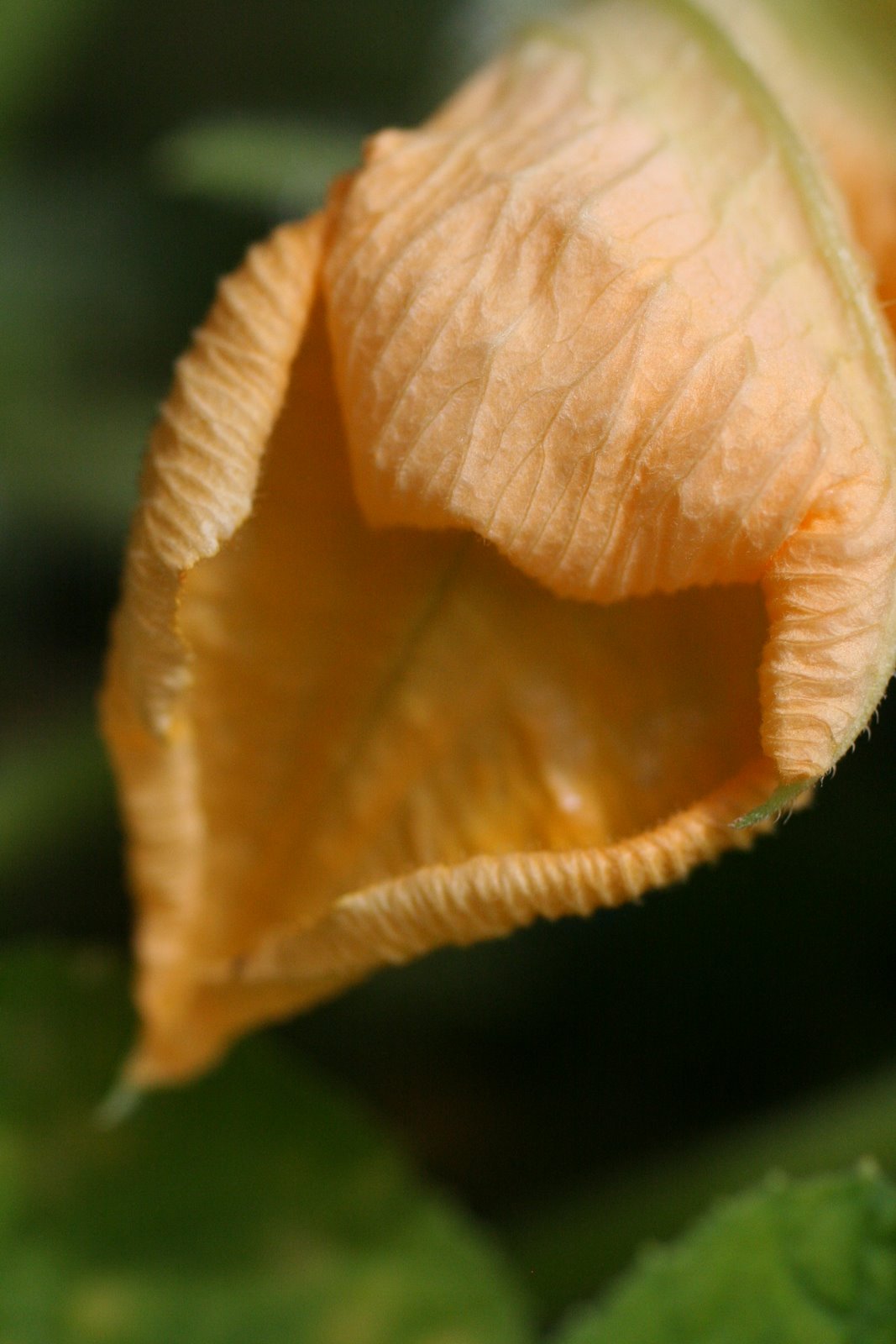
Sunday, 2 December 2007
Green Thumb Sunday- Fragrant Flowers
Coffee Arabica- Possibly the most exquisite flower that I have ever smelled. It is truly beyond description. However is is extremely short lived as the flowers seldom last more than a day or two.
This photograph is an older one and is not one of my own. It was taken by my friend Michele Jorsling, an excellent photographer with a sense of adventure. She is always willing to come along and shoot under the most precarious conditions. Up ladders, in trees, perched on rocks.....
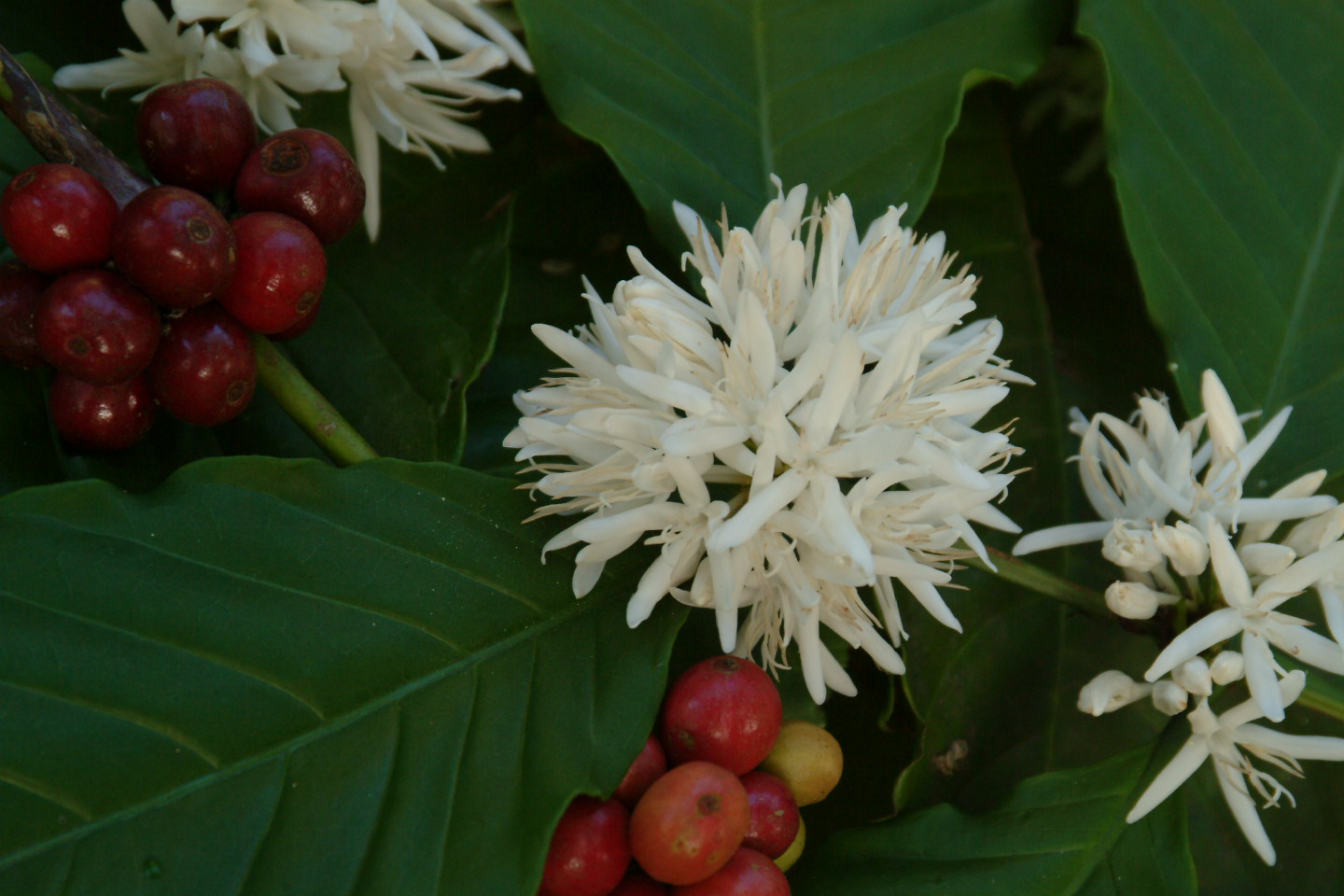
Scented flowers make my garden magical. The scents are usually subtle, except for coffee which is unbeliveably strong. I've posted on several of these before, but the shots are probably different. The white and yellow flowers below belong to the white begonia. Many people do not realize that they are scented because they are so subtle. The larger the clumps, the stronger the soft smell early in the morning or at night.

This is my "chick vine". This follwing information is from the website http://www3.interscience.wiley.com/cgi-bin/abstract/102522633/ABSTRACTA .....a new cytotoxic limonoid from Odontadenia macrantha from the Suriname rainforest has been identified as showing promise in the area of ovarian cancer research. "Bioassay-guided fractionation of the methanol extract of Odontadenia macrantha afforded a new limonoid, odontadenin A (1) and two known triterpenoids, lupeol (2) and
 -amyrin (3). The structure of 1 was established on the basis of 1D and 2D NMR and high-resolution fast atom bombardment mass spectrometric data. The new compound was found to possess moderate cytotoxicity against A2780, the ovarian cancer cell line. Copyright © 2003 John Wiley & Sons, Ltd.
 I have always been drawn to this vine and have learned how to propagate it fairly effectively. This type of plant makes me feel so very strongly about rainforest preservation because, I know we've heard it so many times, but I think the cure for almost everything lies hidden in the deep rainforest. It will just take us years to find them. if there is no more rain forest- then that option is gone forever. Sad. But in the meantime, my chick vine and I are continuing our love affair. She has pods on her right now, growing a whole new batch of seeds.
This photo of honeysuckle is one of my favorite photographs. Another scented beauty, the night scent is that of true honeysuckle. I would love to know who was the first person to sit rolling these words on his tongue- a new name......honeysuckle. Such a magical, fairy name.
 One of my hoyas. This one is also scented with a musky, sweet smell. The perfection of each hoya bloom never fails to amaze me. I can usually tell what is in bloom when I walk around the garden at night. Tropical nights are exquisitely beautiful. We are moving rapidly into dry season and our sunsets are becoming spectacular. Not showy but the sky goes a soft pinky, yellowy. Almost like the inside of a Queen Conch shell and the air is like velvet at the hour of the day.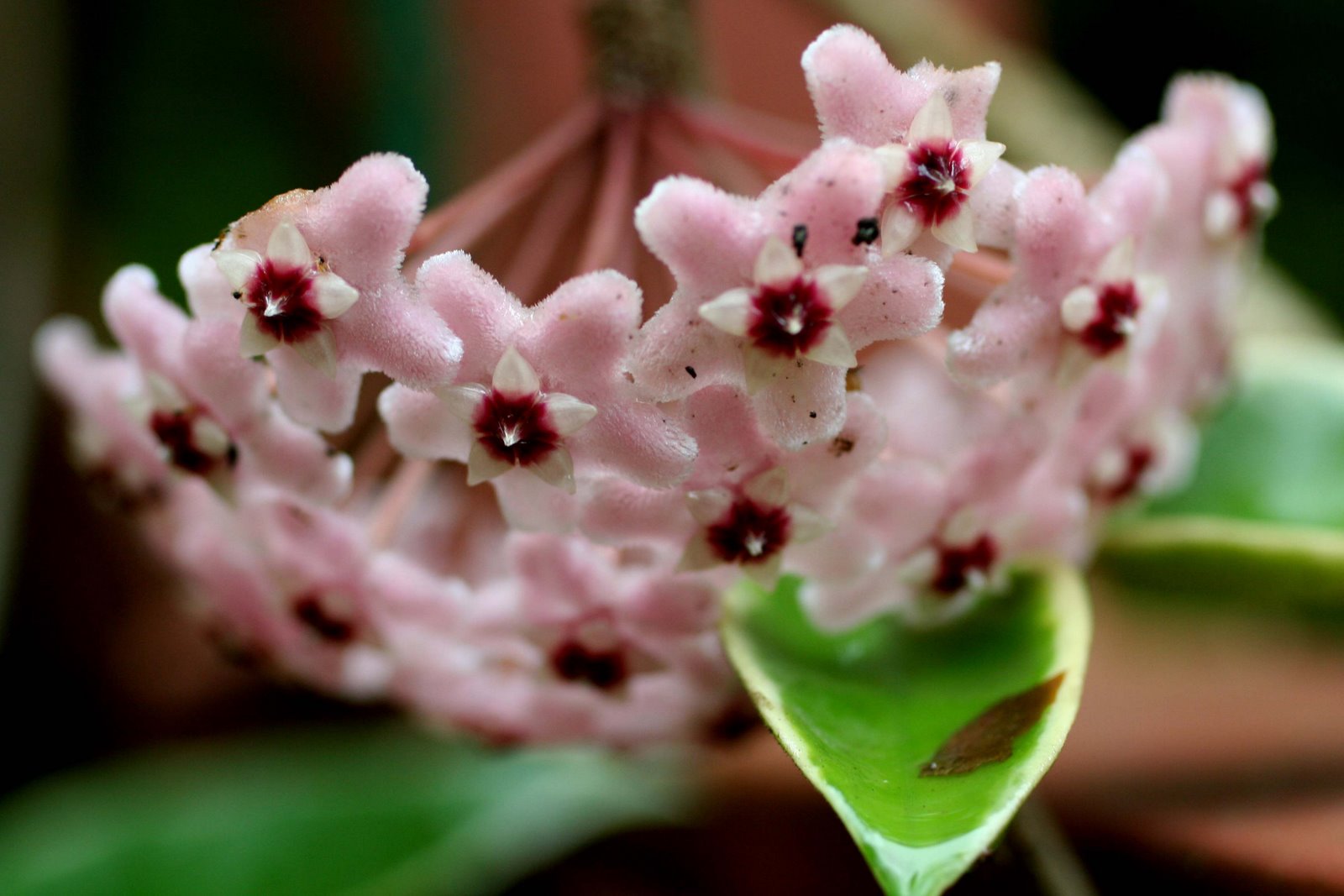
This is my blue iris which is in bloom. It blooms when it feels like it. No rhyme or reason that i can figure out. It is also quite deeply scented. This is an older shot but is one of my favorites.

Happy Green Thumb Sunday
Wednesday, 28 November 2007
The Land of Plenty
I'm continuing my edible theme to remind myself how lucky we are to have so many delicious things growing around us in the Tropics. We don't grow apples and pears, or peaches, blueberries, strawberries or raspberries. But we do grow pineapples, bananas, guavas, sapodillas, mangoes, sugar apples, West Indian cherries, clove, cinnamon, nutmeg, cocoa, coffee, roucou, cashews and pommecythere, to name a few.  Pineapple is a bromeliad. My gardener calls all bromeliads "wild pine". I know the fancy hybrids are insulted! Pineapple is most delicious with a slight sprinkle of salt and cut in fat chunks.
 Cinnamon is a bark. Mauby, the ever-popular bitter beverage, is also a bark that is brewed to make a drink. I don't have a picture of a clove tree but I remember the first time that I saw one. My brother-in-law had an estate deep in the Northern village of Brasso Seco. A neglected cocoa estate, there was a lovely river running through it and some wonderful forest trees. One of these trees was a clove tree. It is an enormous tree and the cloves are red. When they fall on the ground, it is an amazing sight as the colour throws you for a second. It looks like a clove but it is bright red. And the smell. Indescribable. I've never seen another clove tree. I would love to plant one, but realistically I don't have the room.
The above odd looking fruit/vegetable is roucou or annatto. It was used as far back as the Amerindians as a preservative and is a very popular additive in our Christmas pastelles. It stains a deep red and has very little flavour. This is the fruit on the tree. Once removed from the tree, it dries and turns brown and the pod splits to reveal the little seeds that provide the colour. Cocoa off my tree. I do believe that I have very good quality cocoa. I bought the tree from the Government farm in Centeno and it gives me big, healthy, pretty cocoa.
This is my favourite fruit, the sugar apple. It grows best under arid conditions and so is happiest "down the islands" where it grows almost wild. It is an unusual fruit that you split open and suck the pulpy white fruit off the black seed. It is quite a labour intensive fruit but well worth the effort. It is sweet with the slightest undertone of of an indescribable flavour.
Post Note on the Dec 1:
I didn't know a whole lot about the sugar apple so could not answer whether it was, in fact, a custard apple. I'm going to cut and paste what I got from Wikepedia which seems to answer the question.
In some regions of the world, the sugar-apple is also known as custard-apple, a different plant in the same genus.
Annona squamosa (Sugar-apple, Sweetsop or Custard Apple) is a species of Annona native to the tropical Americas. Its exact native range is unknown due to extensive cultivation, but thought to be in the Caribbean; the species was described from Jamaica.
It is a semi-evergreen shrub or small tree reaching 6-8 m tall. The leaves are alternate, simple, oblong-lanceolate, 5-17 cm long and 2-5 cm broad. The flowers are produced in clusters of 3-4, each flower 1.5-3 cm across, with six petals, yellow-green spotted purple at the base.
The fruit is usually round or oval, slightly pine cone-like, 6-10 cm diameter and weighing 100-230 g, with a scaly or lumpy skin. The fruit flesh is edible, white to light yellow, and resembles and tastes like custard. The seeds are scattered through the fruit flesh; they are blackish-brown, 12-18 mm long, and hard and shiny.