Sunday, 2 December 2007

Green Thumb Sunday- Fragrant Flowers

Join Green Thumb Sunday

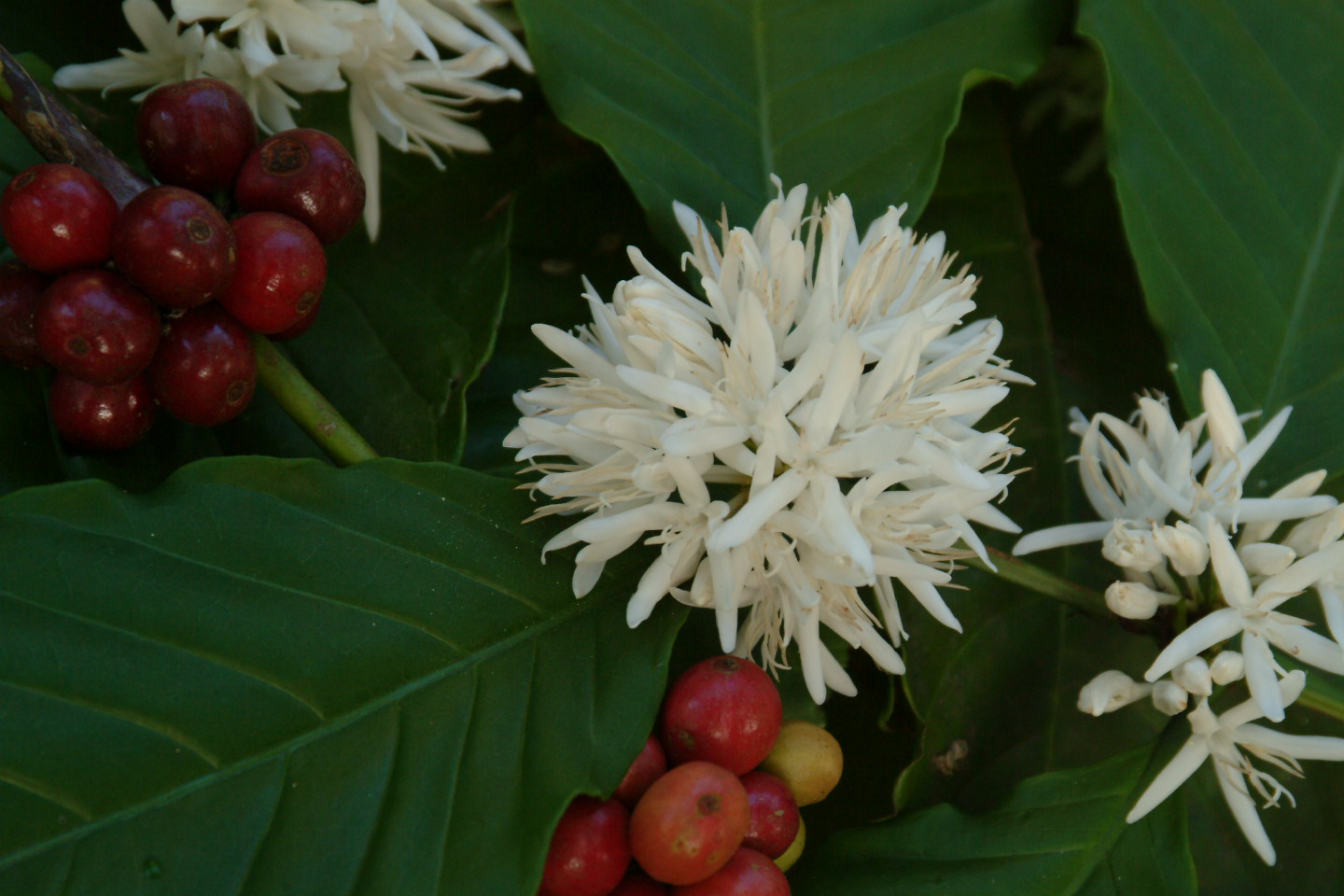
Coffee Arabica- Possibly the most exquisite flower that I have ever smelled. It is truly beyond description. However is is extremely short lived as the flowers seldom last more than a day or two.


This photograph is an older one and is not one of my own. It was taken by my friend Michele Jorsling, an excellent photographer with a sense of adventure. She is always willing to come along and shoot under the most precarious conditions. Up ladders, in trees, perched on rocks.....
Scented flowers make my garden magical. The scents are usually subtle, except for coffee which is unbeliveably strong. I've posted on several of these before, but the shots are probably different. The white and yellow flowers below belong to the white begonia. Many people do not realize that they are scented because they are so subtle. The larger the clumps, the stronger the soft smell early in the morning or at night.


This is my "chick vine". This follwing information is from the website http://www3.interscience.wiley.com/cgi-bin/abstract/102522633/ABSTRACTA .....a new cytotoxic limonoid from Odontadenia macrantha from the Suriname rainforest has been identified as showing promise in the area of ovarian cancer research. "Bioassay-guided fractionation of the methanol extract of Odontadenia macrantha afforded a new limonoid, odontadenin A (1) and two known triterpenoids, lupeol (2) and -amyrin (3). The structure of 1 was established on the basis of 1D and 2D NMR and high-resolution fast atom bombardment mass spectrometric data. The new compound was found to possess moderate cytotoxicity against A2780, the ovarian cancer cell line. Copyright © 2003 John Wiley & Sons, Ltd.

I have always been drawn to this vine and have learned how to propagate it fairly effectively. This type of plant makes me feel so very strongly about rainforest preservation because, I know we've heard it so many times, but I think the cure for almost everything lies hidden in the deep rainforest. It will just take us years to find them. if there is no more rain forest- then that option is gone forever. Sad. But in the meantime, my chick vine and I are continuing our love affair. She has pods on her right now, growing a whole new batch of seeds.


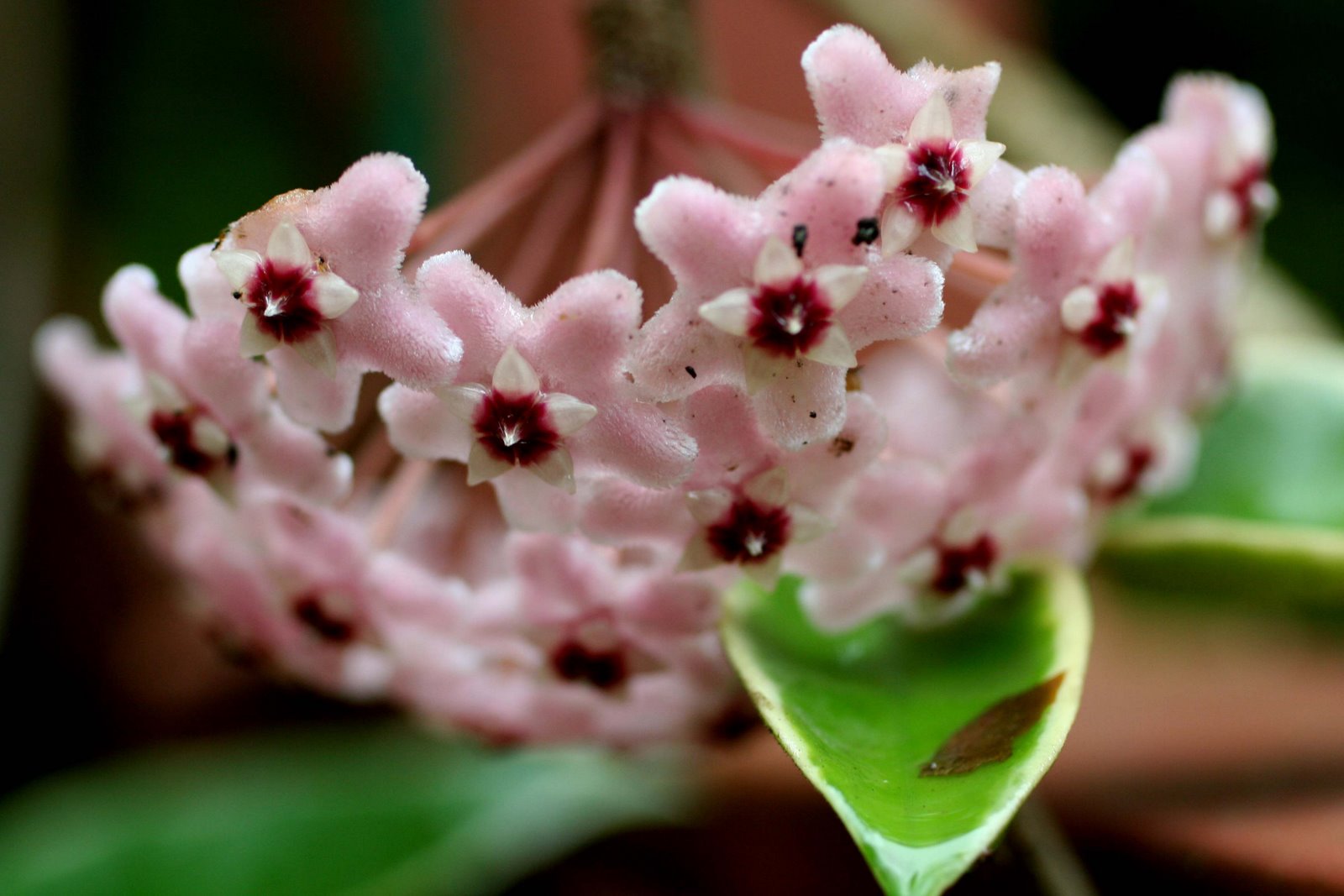
This photo of honeysuckle is one of my favorite photographs. Another scented beauty, the night scent is that of true honeysuckle. I would love to know who was the first person to sit rolling these words on his tongue- a new name......honeysuckle. Such a magical, fairy name.One of my hoyas. This one is also scented with a musky, sweet smell. The perfection of each hoya bloom never fails to amaze me. I can usually tell what is in bloom when I walk around the garden at night. Tropical nights are exquisitely beautiful. We are moving rapidly into dry season and our sunsets are becoming spectacular. Not showy but the sky goes a soft pinky, yellowy. Almost like the inside of a Queen Conch shell and the air is like velvet at the hour of the day.
This is my blue iris which is in bloom. It blooms when it feels like it. No rhyme or reason that i can figure out. It is also quite deeply scented. This is an older shot but is one of my favorites.

Happy Green Thumb Sunday

Wednesday, 28 November 2007

The Land of Plenty

I'm continuing my edible theme to remind myself how lucky we are to have so many delicious things growing around us in the Tropics. We don't grow apples and pears, or peaches, blueberries, strawberries or raspberries. But we do grow pineapples, bananas, guavas, sapodillas, mangoes, sugar apples, West Indian cherries, clove, cinnamon, nutmeg, cocoa, coffee, roucou, cashews and pommecythere, to name a few. Pineapple is a bromeliad. My gardener calls all bromeliads "wild pine". I know the fancy hybrids are insulted! Pineapple is most delicious with a slight sprinkle of salt and cut in fat chunks.
Cinnamon is a bark. Mauby, the ever-popular bitter beverage, is also a bark that is brewed to make a drink. I don't have a picture of a clove tree but I remember the first time that I saw one. My brother-in-law had an estate deep in the Northern village of Brasso Seco. A neglected cocoa estate, there was a lovely river running through it and some wonderful forest trees. One of these trees was a clove tree. It is an enormous tree and the cloves are red. When they fall on the ground, it is an amazing sight as the colour throws you for a second. It looks like a clove but it is bright red. And the smell. Indescribable. I've never seen another clove tree. I would love to plant one, but realistically I don't have the room.

The above odd looking fruit/vegetable is roucou or annatto. It was used as far back as the Amerindians as a preservative and is a very popular additive in our Christmas pastelles. It stains a deep red and has very little flavour. This is the fruit on the tree. Once removed from the tree, it dries and turns brown and the pod splits to reveal the little seeds that provide the colour.
Cocoa off my tree. I do believe that I have very good quality cocoa. I bought the tree from the Government farm in Centeno and it gives me big, healthy, pretty cocoa.

This is my favourite fruit, the sugar apple. It grows best under arid conditions and so is happiest "down the islands" where it grows almost wild. It is an unusual fruit that you split open and suck the pulpy white fruit off the black seed. It is quite a labour intensive fruit but well worth the effort. It is sweet with the slightest undertone of of an indescribable flavour.
Post Note on the Dec 1:
I didn't know a whole lot about the sugar apple so could not answer whether it was, in fact, a custard apple. I'm going to cut and paste what I got from Wikepedia which seems to answer the question.

In some regions of the world, the sugar-apple is also known as custard-apple, a different plant in the same genus.

Annona squamosa (Sugar-apple, Sweetsop or Custard Apple) is a species of Annona native to the tropical Americas. Its exact native range is unknown due to extensive cultivation, but thought to be in the Caribbean; the species was described from Jamaica.

It is a semi-evergreen shrub or small tree reaching 6-8 m tall. The leaves are alternate, simple, oblong-lanceolate, 5-17 cm long and 2-5 cm broad. The flowers are produced in clusters of 3-4, each flower 1.5-3 cm across, with six petals, yellow-green spotted purple at the base.

The fruit is usually round or oval, slightly pine cone-like, 6-10 cm diameter and weighing 100-230 g, with a scaly or lumpy skin. The fruit flesh is edible, white to light yellow, and resembles and tastes like custard. The seeds are scattered through the fruit flesh; they are blackish-brown, 12-18 mm long, and hard and shiny.

Tuesday, 27 November 2007

Fruit and Veggies at the Parlour

When I was growing up, we ran to the parlour at the end of the road for everything from salt prunes, pepper mango and pennycools (sp?) to milk, sugar and eggs. The concept of the "parlour" is a distinctly Caribbean one. We have them all throughout the islands . Basically roadside shops, they sell an assortment of culinary haberdashery. Each country will have their own version of snacks but the true beauty of these little shops is in their fruit and vegetables. Most, if not all, of the produce has never been refrigerated. It is being sold usually within a mile or two from its source. Many of the things that show up in country parlours never make into the big supermarkets. You may be lucky and chance upon a batch of cherry tomatoes or a grappe of extra big pommeracs (malay apples). I have three or four parlours around my neighbourhood. Boysie's is run by Angela, Terrence and sisters. Terrence is the golden boy and is a wise sage for his age. He is always ready with cryptic advice. Located less than a quarter mile from the country's mental asylum or the "Mad House", a visit to Boysie's to pick up newspapers, maggi cubes, or my constant addiction, Diet Coke!, is often excitement filled. The melee of mentally challenged drifters sound more ominous than they really are. They are harmless (mostly) and can be quite amusing delivering their sotto voice social commentaries from the sidelines with a comical , cruel clarity. I made the mistake of arriving the other day without lipstick (BIG CRIME for the mentally challenged) and got told off for appearing without it. Oh the joys of life in the tropics. You have to laugh!These were some of the offerings at the parlour yesterday. Above is Caraili, or bitter gourd. It is supposed to be quite a delicacy and is stuffed by many of the Chinese restaurants. I can't eat it at all, it is too bitter for me. If you say you can eat cariilii, I look at you with new respect. It is BITTER. Trinifood over at Can Cook, Must Cook has some great things to say about caraili.
Lovely scotch bonnet peppers.
Home grown ochroes. I like to see the little twists and turns of an imperfect vegetable as it says to me that maybe a whole lot of chemicals were not used to produce it. Perfection makes me suspicious.Pawpaw or papaya ready to be eaten. I sometimes have a slice for breakfast with just a dash of lime and a sprinkle of brown sugar. Pawpaw seeds very easily but there is a story about male and female trees and if you get the male, no fruit.
Terrence giving somebody chat.

Sunday, 25 November 2007

Green Thumb Sunday

This is my first Green Thumb Sunday Post so I'm quite excited. These are some of the things in bloom in my garden right now. I have learnt from bitter experience that it is best not to fight my landscape and grow what does best in the rather odd soil of the Northern Range. Heliconias love the soil and grow to almost pre-historic size. My soil appears to be quite alkaline because I have to feed very heavily with things like Miracid and chelated iron, if I don't many of my shrubs suffer from pale leaves. Heliconias and orchids do fine.
I'm ashamed to say I don't know the name of this showy little orchid. It starts out purple and goes paler and paler as it gets older.
This is commonly known as "Blue Ginger" but is in fact not a ginger at all. It belongs to the Commelinaceae or Spiderwort family so is related to the Wandering Jew. It looks like a costus hence the name. Its important name is Dichorsanda thyrisiflora. It is one of my favourite blooms because of its unusual colour. This deep blue is not an easy colour to find and it always adds the depth and interest that you must have in a successful bed.
I've posted on this shot before. This is one of my favorite views of my home. I love the demerara windows with the bougainvillea cascading over them. This is my laundry and store room, so no one actually lives here.
The heliconias and ornamental bananas are the biggest bird pullers in my garden. Until I grew them, I had no idea the vast avian population that is drawn to these species. The Sexy Red or heliconia collinsiana in particular, is a huge favorite with the tanagers and the hummingbirds.
The Musa (or ornamental) bananas are a great addition because they are consistent bloomers once the conditions are right. The beauty above is the Musa Royal Purple and it is one of the larger ones, getting up to about 9-10 feet. To keep them from overpowering the garden, I keep the foliage quite sparse. I find this way I can see the bracts or the bananas and the light can get down to the new suckers to help them on their way. Many people are turned off of heliconias and bananas because of their tendency to take over a garden. But like everything else, if managed properly, they know their place!

Green Thumb Sunday
Join Green Thumb Sunday
Join


Thursday, 22 November 2007

Botanical Gardens in Nevis

I dug into my archives because I was suddenly in the mood for Nevis. The Botanical Gardens there are not terribly old but are absolutely beautiful. This scene was so straight out of a children's storybook that I had to capture it.
A single pan man. One pan around the neck can be just as dramatic as a whole band. In Trinidad right now, because the Carnival season is so early next year, all the steelbands have begun practicing. I can lie in my bed at night and listen to the pan being played on the hill. Some nights they go through a batch of carols and it is really lovely.
The cascading water coppers make for a dramatic central water feature. These authentic coppers often date back to the 18th century when they were used on the sugar estates to boil the cane juice to produce sugar.
Bromeliads have been put to quite dramatic use here with the differing colours providing the necessary contrast for a well sculpted bed. Bromeliads are an excellent choice for this type of effect as they are hardy and less prone to the bacterial and fungal threats that affect other plants. Their spiky, hard shape can provide the balance crucial in effective landscaping.

Tuesday, 20 November 2007

Back up and running

I just lost my entire post! Arrrggghhhh
My theme was red.
Anyway, I've been having some trouble with Blogger over the last few days but it seems as if I am back in the saddle.

This lovely red shampoo ginger (Zingiber zerumbet) looks firm but is actually deliciously squishy. It is still the season for gingers and heliconias. My shampoos haven't done anything for me this year- maybe when the rains stop.

The yellows and pink of this upright heliconia are a wonderful contrast to all the surrounding green.A particularly attractive costus that often dies back in the dry season only to make a reappearance once the rains return.


Ixoras are much maligned for being a tropical cliche but as with most cliches, they do carry a lot of clout. They are bright, steady bloomers with a wide range of colour variations. Poor things, they were just too much of a good thing.
Hummingbirds love them. So do children. A whole generation of West Indian children spent many a sleepy afternoon drawing the sweet nectar out of each star shaped flower. We never ate the flower, just drank the nectar .I know this is a heliconia bihai but I'm not sure which one. I know it's not Richmond Red. Maybe the Red She???


Friday, 16 November 2007

Hello Caribbean Garden!

I felt as if I was going on a blind date. Nicole (Tira) from A Caribbean Garden was in Trinidad this week and we managed to hook up for a day of garden visiting and photographing.
She's lovely and has a wonderful sense of humour with a big, big laugh. :)
Here she is chatting with Chris Talma of Foliage Designs who runs one of the larger nuseries on the island. His property is located deep in the Santa Cruz valley, on a slightly raised bluff that looks onto the Northern Range.

While walking on the lovely nature trail that is punctuated by several varieties of heliconia, we chanced upon this barred Anshrik. They are not rare but, neither are they common. I was very happy to get so close to him as to see his red eyes.

Just one of the statues that appear on the trail as you meander your way through the Foliage Design garden.
Lovely pommerac or Malay Apple seldom lasts long on the tree and it is best eaten right off the branch.